

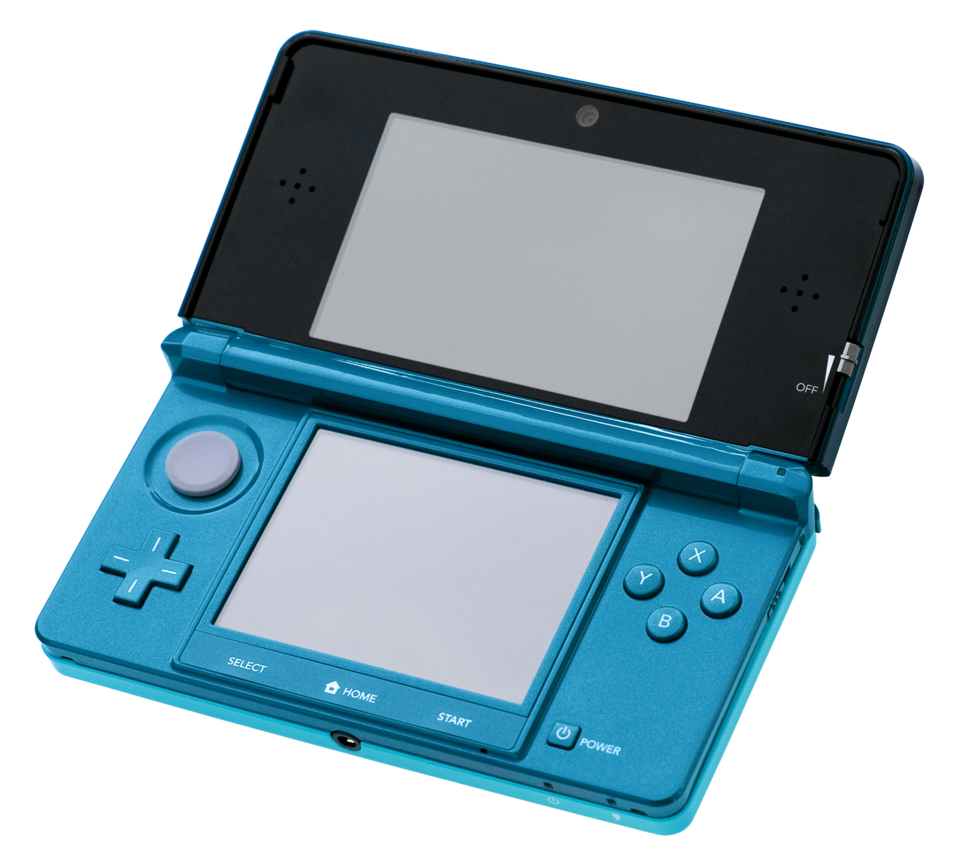
The Nintendo 3DS, released in 2011, was the successor to the Nintendo DS and brought glasses-free stereoscopic 3D to handheld gaming for the first time. Building on the dual-screen design of its predecessor, the 3DS featured an improved upper screen capable of displaying 3D visuals, a 3D depth slider, a Circle Pad for analog movement, built-in gyroscope and accelerometer, and StreetPass/SpotPass capabilities for sharing data and connecting wirelessly. Though its launch was rocky due to a high price and lackluster early titles, Nintendo quickly adjusted with a price drop and a flood of top-tier games.
The 3DS eventually developed one of the most celebrated handheld libraries in Nintendo’s history. Flagship titles like Pokémon X & Y, Animal Crossing: New Leaf, The Legend of Zelda: A Link Between Worlds, Fire Emblem: Awakening, and Mario Kart 7 defined the system. It also became a home for enhanced remakes and ports such as Ocarina of Time 3D, Majora’s Mask 3D, and Luigi’s Mansion. The 3DS family also introduced several hardware iterations, including the Nintendo 2DS, New Nintendo 3DS, and New Nintendo 2DS XL, each offering various refinements and price points.
Selling over 75 million units worldwide, the 3DS continued Nintendo’s dominance in handheld gaming during an era increasingly influenced by smartphones and mobile apps. Though the 3D feature gradually became less emphasized, the system’s unique design, strong first-party support, and backward compatibility with DS games gave it an enduring legacy. The Nintendo 3DS closed out the dual-screen era of portables with innovation, charm, and one of the most consistently impressive libraries in handheld history.
Nintendo 3DS Technical Specifications
| Component | Specification |
|---|---|
| CPU | Dual-core ARM11 MPCore @ 268 MHz |
| GPU | DMP PICA200 @ 268 MHz (supporting shaders, lighting, and 3D effects) |
| Top Screen | 3.53” autostereoscopic 3D display (800×240 total resolution, 400×240 per eye) |
| Bottom Screen | 3.02” resistive touchscreen (320×240 resolution) |
| Sound | Stereo speakers, microphone, headphone jack |
| Media | Game cards (up to 8GB), SD card storage, digital downloads |
| Wireless | Wi-Fi 802.11 b/g (multiplayer, SpotPass, StreetPass) |
| Battery Life | 3–8 hours (varies by model and game) |
| Backward Compatibility | Nintendo DS/DSi cartridges |
| Release Date | 2011 (Worldwide) |