

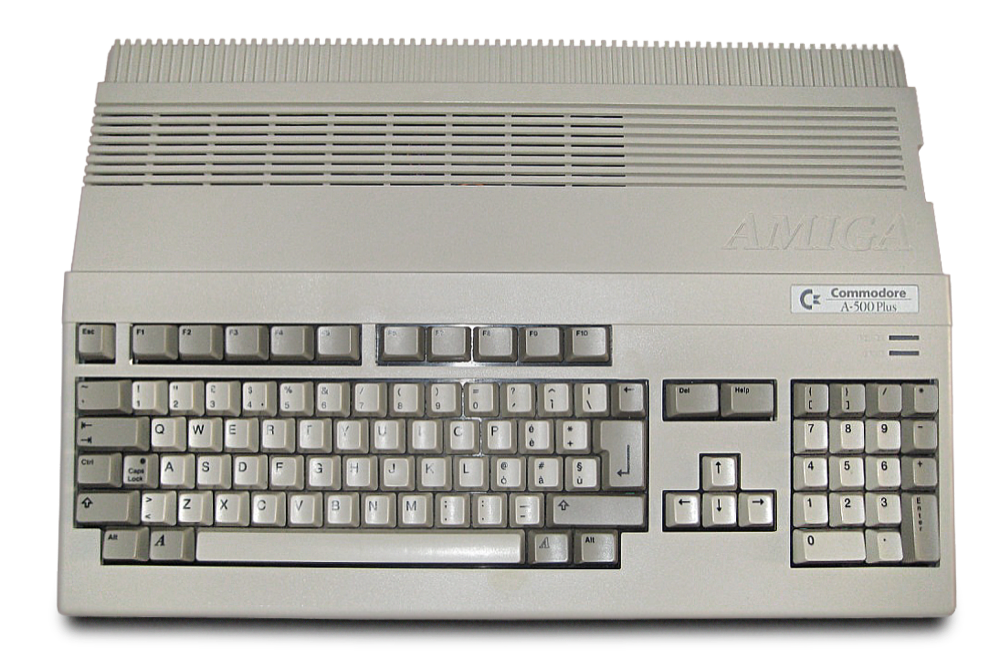
The Commodore Amiga began as the Amiga 1000, announced and sold from July 23, 1985. Jay Miner and the team at Amiga Corporation had designed custom chips—Agnus, Denise, and Paula—around a Motorola 68000. Commodore bought the company after the 1983 crash left Atari and others circling the same design. A pre-emptive multitasking OS, AmigaOS, and the Workbench desktop sat on top. Early machines were scarce and pricey. The cost-cut Amiga 500 of 1987 is the model most people owned: a keyboard with the computer inside, 512 KB of Chip RAM, and a 3.5-inch floppy.
Those custom chips gave games a head start over contemporary PCs. Lemmings and Populous started here before they went everywhere. Another World and Shadow of the Beast showed what a blitter and a 4,096-color HAM mode could look like. Defender of the Crown sold the machine as cinema. Paula’s four 8-bit PCM channels made trackers a native art form. The same hardware genlocked video; NewTek’s Video Toaster turned later Amigas into cheap TV suites.
Commodore sold about 4.85 to 4.91 million Amigas before the company filed for bankruptcy in April 1994. The line was strongest in the United Kingdom and Germany, weaker in North America. IBM PC compatibles with VGA, then 16-bit consoles, ate the living room. Escom and others kept a few models alive for a short time. The Amiga remains the 16-bit home computer that treated games, music, and video as one machine—and the one WinUAE and similar projects still keep whole.
Amiga Technical Specifications
| Component | Specification |
|---|---|
| CPU | Motorola 68000 @ 7.16 MHz (NTSC) / 7.09 MHz (PAL) on A1000 / A500 |
| Graphics | OCS Denise + Agnus; HAM up to 4,096 colors; later ECS / AGA |
| Resolution | 320×200 / 320×256 typical; 640×256 and higher display modes |
| Sound | Paula; 4-channel 8-bit PCM stereo |
| Media | 3.5-inch floppy; later hard disks and CD32 disc |
| Memory | 256 KB (A1000) or 512 KB Chip RAM (A500 typical); expandable |
| OS | AmigaOS (Kickstart + Workbench) |
| Controllers | Keyboard; 2× Atari-style joystick / mouse ports |
| Release Date | July 23, 1985 (A1000); 1987 (A500) |
| Units Sold | ~4.85–4.91 million (all Amiga models) |