

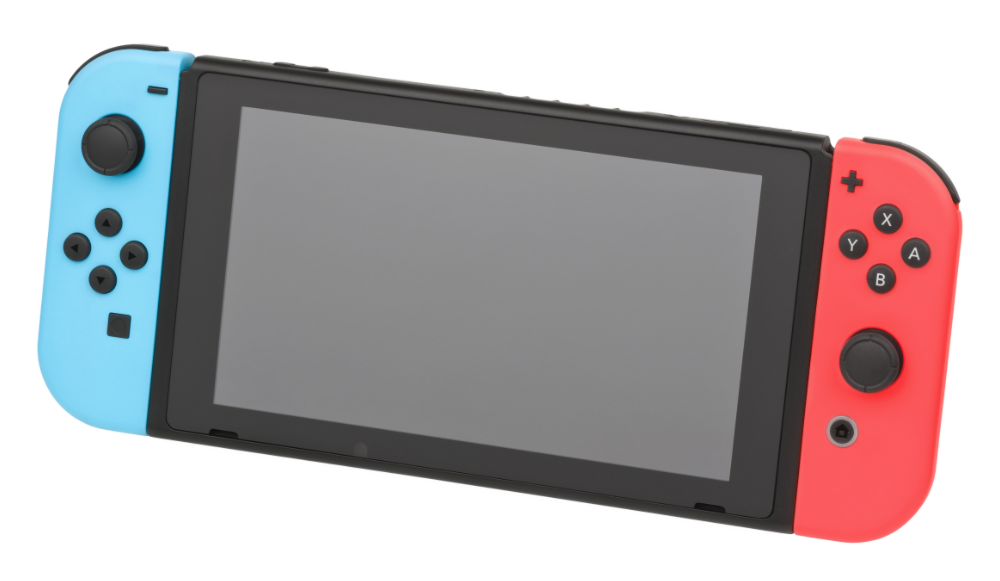
Released in March 2017, the Nintendo Switch marked a bold and defining moment in gaming history. After the commercial failure of the Wii U, Nintendo pivoted toward a hybrid design philosophy: a single console that could seamlessly transition between handheld, tabletop, and docked TV modes. This innovation blurred the line between home console and portable gaming, giving players the flexibility to play wherever and however they wanted. Backed by an impressive launch title, The Legend of Zelda: Breath of the Wild, the Switch quickly became a global success.
The Switch revitalized Nintendo’s hardware and software ecosystems. It saw landmark releases like Super Mario Odyssey, Animal Crossing: New Horizons, Pokémon Legends: Arceus, and Metroid Dread, alongside strong indie support and surprising third-party ports. Its detachable Joy-Con controllers introduced new ways to play, featuring motion controls, HD rumble, and local multiplayer anywhere. Online functionality expanded over time, with Nintendo Switch Online providing access to cloud saves and retro game libraries (NES, SNES, N64, and GBA), and later the Expansion Pack tier.
The console’s appeal was further broadened by new models: the Switch Lite (a handheld-only version) in 2019 and the OLED Model in 2021, which featured an improved screen and audio but no major performance boost. As of 2025, the Switch has sold over 139 million units, making it one of the best-selling video game consoles of all time, rivaling the PS2 and Nintendo DS. Its influence is vast—merging Nintendo’s handheld and home console development into one unified platform—and its success is expected to shape future generations of Nintendo hardware.
Nintendo Switch Technical Specifications
| Component | Specification |
|---|---|
| CPU/GPU | NVIDIA Custom Tegra X1 (quad-core ARM Cortex-A57 + Maxwell GPU) |
| RAM | 4 GB LPDDR4 (OLED model: 4 GB; Switch 2 rumored to use 8–12 GB) |
| Storage | 32 GB internal (OLED model: 64 GB); expandable via microSDXC (up to 2 TB) |
| Display | 6.2” LCD (720p); OLED model: 7” OLED (720p handheld, up to 1080p docked) |
| Controllers | Detachable Joy-Cons with HD rumble, motion sensors, IR camera (R Joy-Con) |
| Battery Life | 2.5–9 hours depending on model and usage |
| Connectivity | Wi-Fi, Bluetooth (audio supported post-firmware), USB-C, HDMI (via dock) |
| Operating System | Nintendo proprietary OS with custom UI |
| Online Services | Nintendo Switch Online (NSO), NSO Expansion Pack |
| Backward Compatibility | Not natively compatible with 3DS/Wii U; Virtual Console replaced by NSO |
| Release Date | March 3, 2017 |