

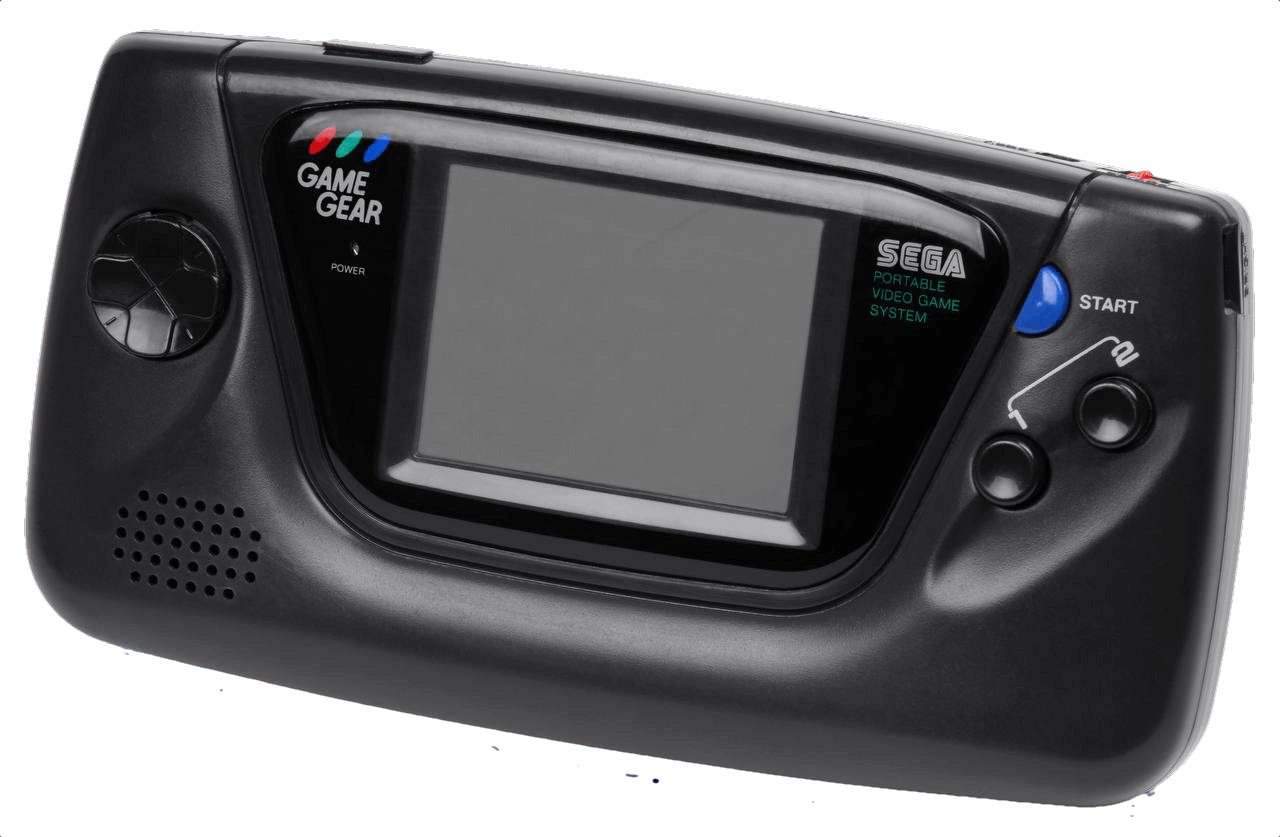
The Sega Game Gear, released in 1990, was Sega’s entry into the growing handheld gaming market and a direct competitor to Nintendo’s Game Boy. Based on the architecture of the Sega Master System, the Game Gear featured a full-color backlit screen, a sleek horizontal layout, and the ability to play TV through an optional tuner—features that made it technologically superior to the Game Boy in many ways. Sega hoped to replicate the success of its Genesis console in the portable space by offering a more advanced, visually appealing alternative.
Despite its technical strengths, the Game Gear struggled in several key areas. Its bulkier size, limited battery life (only 3–5 hours on six AA batteries), and higher price point made it less practical than the Game Boy for everyday use. While it had a decent game library—including titles like Sonic the Hedgehog, Shining Force: The Sword of Hajya, Columns, and GG Shinobi—many of its releases were scaled-down Master System ports, and third-party support was limited. Accessories like the Master Gear Converter allowed Master System cartridges to be played on the Game Gear, but they couldn’t make up for the relatively short battery life and smaller library.
The Game Gear sold around 10 million units worldwide, making it the most successful Game Boy competitor of its era—but still far behind Nintendo’s juggernaut. While it never reached mainstream dominance, it helped cement Sega’s reputation for innovation and remains a nostalgic favorite among retro handheld enthusiasts. Its vibrant screen and arcade-style gameplay left a lasting impression on gamers who experienced its bold, colorful vision of portable gaming.
Sega Game Gear Technical Specifications
| Component | Specification |
|---|---|
| CPU | Zilog Z80 @ 3.58 MHz |
| Graphics | 160×144 resolution, 4096-color palette (32 on-screen simultaneously) |
| Display | 3.2-inch backlit color LCD |
| Sound | 1 mono speaker, stereo via headphones |
| Battery Life | Approx. 3–5 hours using 6 AA batteries |
| Media | ROM cartridges (Game Gear-specific, some Master System compatibility) |
| Release Date | 1990 (Japan), 1991 (North America and Europe) |