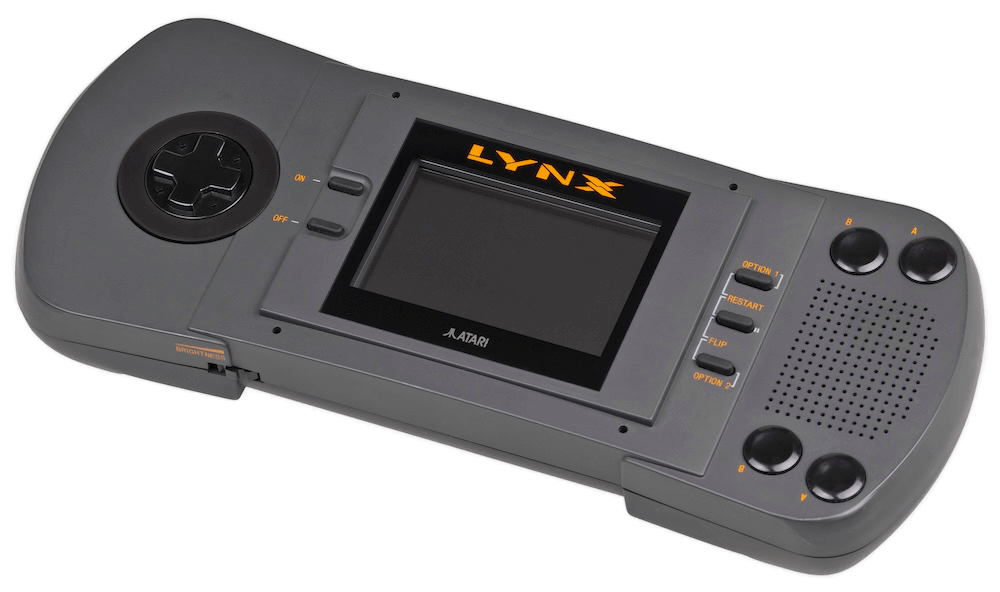
The Atari Lynx, released in September 1989, was Atari’s bold entry into the handheld gaming market. Co-developed with Epyx, it was the first handheld console to feature a full-color LCD screen, giving it a technical edge over Nintendo’s monochrome Game Boy, which launched the same year. The Lynx also offered advanced features like hardware sprite scaling and rotation, a backlit display, and the innovative ComLynx networking system, which allowed up to 17 players to link their systems together for multiplayer matches.
Despite these innovations, the Lynx struggled in the marketplace. Its high price, bulky size, and extremely short battery life (often draining six AA batteries in under five hours) made it less practical than the Game Boy. Additionally, Atari’s limited marketing and smaller game library failed to capture widespread developer and consumer support. While titles such as California Games, Blue Lightning, and Chip’s Challenge showcased its capabilities, the Game Boy’s affordability and massive third-party lineup gave Nintendo the decisive edge.
The Lynx remained in production until 1996, selling around 3 million units worldwide. Though not a commercial success, it left a lasting impression as a technologically ambitious console ahead of its time, remembered fondly by enthusiasts for its groundbreaking hardware features.
Atari Lynx Technical Specifications
| Component | Specification |
|---|---|
| CPU | 16-bit MOS 65SC02 @ 4 MHz |
| Co-Processor | Custom 16-bit graphics chip (“Suzy”) for scaling and rotation |
| RAM | 64 KB |
| Display | 3.5” backlit color LCD, 160×102 pixels |
| Colors | 16 simultaneous on-screen from a palette of 4096 |
| Sound | 4-channel stereo |
| Media | ROM cartridges (up to 512 KB) |
| Controllers | D-pad, 2 action buttons, flip design for left- or right-handed play |
| Networking | ComLynx cable support (up to 17 players) |
| Release Date | September 1989 |
| Discontinuation | 1996 |
| Units Sold | ~3 million |