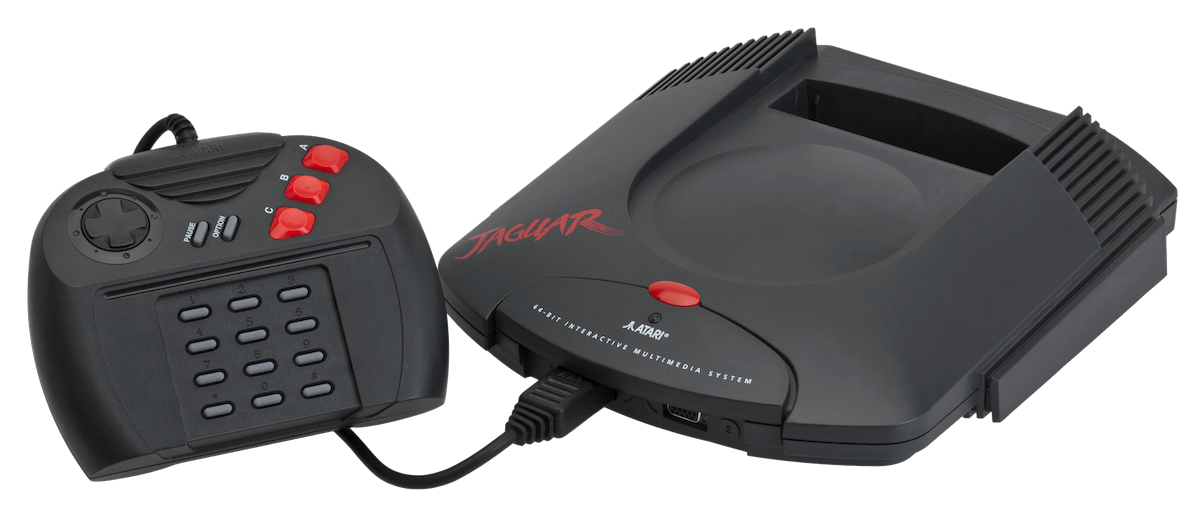
The Atari Jaguar, released in November 1993, was Atari’s final attempt to remain competitive in the home console market. Marketed as the world’s first 64-bit console, its hardware architecture was in reality a complex mix of 32-bit and 64-bit processors. While ambitious, this multi-chip design made the system notoriously difficult to develop for, limiting third-party support and leading to a small and inconsistent library.
Despite some standout titles such as Alien vs. Predator (1994), Tempest 2000 (1994), and a port of Doom (1994), the Jaguar struggled to attract developers and consumers. Its bulky controller, with a full numeric keypad, was also criticized for being unwieldy. In 1995, Atari attempted to revitalize interest with the Jaguar CD add-on, but it suffered from poor build quality and limited games, further damaging the system’s reputation.
With fewer than 250,000 units sold, the Jaguar was a commercial failure and marked the end of Atari’s role as a console manufacturer. By the mid-1990s, Atari shifted away from hardware entirely, eventually being acquired and restructured under new ownership. The Jaguar, however, has since become a cult favorite among collectors and retro enthusiasts, remembered as both a bold experiment and a symbol of Atari’s decline.
Atari Jaguar Technical Specifications
| Component | Specification |
|---|---|
| Main Processors | “Tom” (Graphics Processing, 32-bit RISC) and “Jerry” (Audio/IO, 32-bit RISC) |
| Support CPU | Motorola 68000 @ 13.3 MHz (used for coordination) |
| RAM | 2 MB |
| Graphics | Object Processor with 64-bit bus, resolutions up to 800×576 |
| Colors | 24-bit palette (16.8 million colors), up to 32,768 on screen |
| Sound | 16-bit stereo, CD-quality via Jerry processor |
| Media | ROM cartridges (up to 6 MB); optional CD add-on |
| Controllers | Large gamepad with D-pad, 3 action buttons, and 12-button keypad |
| Release Date | November 1993 |
| Discontinuation | 1996 |
| Units Sold | < 250,000 |